It was noticeable in the CWT last night that 15m was open longer into North America and further west too. It was nice to have a quick chat with Jim VE7ZO just prior to the contest starting and John VE3EJ was very loud as were a number of the US stations. Nice too to work Allan VK2GR on 20m during the contest. Just before the end of the hour, I noticed that Barry VK2BJ was on 10MHz, so I hopped over there and had a nice QSO with him. Last contact of the night before turning in was Gabe WN7JT doing a POTA activation over in Washington state. He wasn't loud, but I was very happy to work him.
And then this morning, I caught David VK3DBD on 20m for a quick chat. More VKs in 12 hours than in some time!
Two metre tropo is reasonable to the south west too. Had a very easy QSO with Keith G8IXN this morning and then mid afternoon, a few periods from CT9ACF, although he seemed to have vanished by the time I got back to the shack.
The K's shot up today - it started off at 1 today and has risen quite sharply, so I guess we're in for some disturbance.
Haven't had a 2 way with CT9ACF, but he's heard me today and I've heard EA8RS, who, so far, hasn't heard me. But some decent 2m tropo down that way.
No entries for a week? No particular reason other than rushing about a bit. Nothing major to report.
On 2m there has been a little enhancement but fairly local - mostly UK stations have been noticeably louder than usual. Nothing much doing on 6m.
HF conditions seem to have changed a little bit and are improving a bit after the summer doldrums. I can't say that I have worked any real DX. It's mostly been SOTA stations and the occasional US station in the evenings, mostly on 18 or 21MHz.
My 'DX Commander Junior' (the fibreglass pole with wires taped up the side of it) has been up all summer. A couple of days back I decided to put the proper DX Commander Signature 9 back up. I'm always a little cautious about whether it's going to behave on 7 and 10MHz, although I now know that if it doesn't, it's just a question of cleaning the connectors on the driven plate and the ground plate. Anyway, after its' summer off, it was just fine and it's nice to have 7 and 10MHz available - the Signature 9 really does work well on those bands. No particular DX worked on those bands yet, but some nice QSOs nonetheless.
Some modest tropo around today. Got the occasional 2m spot from EA1UR during the afternoon and worked a few stations around Devon and the south coast.
Not too much doing on HF during the day, but nice to work Bud AA3B operating V26K on 17m in the evening. W1AW much louder on 17m this evening compared to the last few days. Mind you with the K up at 4, it might be that we're about to have another dive in conditions.
I see RI1FJZ has got to the island today, so they should be up and running soon.
Spent the morning doing the PW column, which is always fun. A bit less this month as there's been less Es and DX generally, around on 6m.
After lunch, I had a listen around on 2m FM as there was a 145 Alive event going on. Only worked a couple of '145 Alive' stations; GI3BRC/P and Keith G8IXN in Cornwall. GI3BRC/P was up and down in fading all the time and were a little hard to work, but it was good to hear them - GI on FM is fairly hard going from here. There was also an Irish Counties contest going on and it was fun to work a good number of Irish portables. Once again there was a fair bit of fading, but I was able to work over towards the west coast of Ireland which is reasonable going from here, on 2m FM at least.
No entries for a couple of days - not too much going on on the air and I've been buzzing around elsewhere.
Mostly SOTA contacts and little in the way of DX. Solar flux is low and the A index has been high.
This morning, EA1UR has been visible on 2m FT8 - no great strength on the vertical but nice to see him. Looking at the tropo map, it's a bit touch and go from here to northern Spain but good from there to the southwest towards EA8 - so. you never know.
Spent a little time watching some presentations from the FOC AGM via Zoom in the afternoon - particularly interesting to see a presentation on the recent Bouvet trip by Adrian KO8SCA. An inhospitable spot for sure. It was quite mind boggling to think that my signals were received there. Other presentations interesting too; Remote and Morconi from I8NHJ and WRTC Revisited by M0DXR.
Popped into the shack just before bed and 18MHz was interesting. ZL4YY coming through - he couldn't hear me on 100W and by the time my amp had warmed up, he'd gone. But interesting to see the path there. TN8GD was on too and I was able to work him ok.
No entries for a couple of days as I've been in Cheltenham.
Got back in time for the last few minutes of the 1300z CWT. Conditions not good - couldn't work John VE3EJ on 15m, although I did work him on 20m.
Popped out for a curry in the evening so again, only the last few minutes of the 1900z CWT but conditions poor. Nothing really doing on 15m and 20m quite poor - a struggle to work some of the usual North Americans on 20m!
No post yesterday as we were pretty busy extracting the honey from one of our beehives. We've ended up with a nice batch of honey, so that's pleasing.
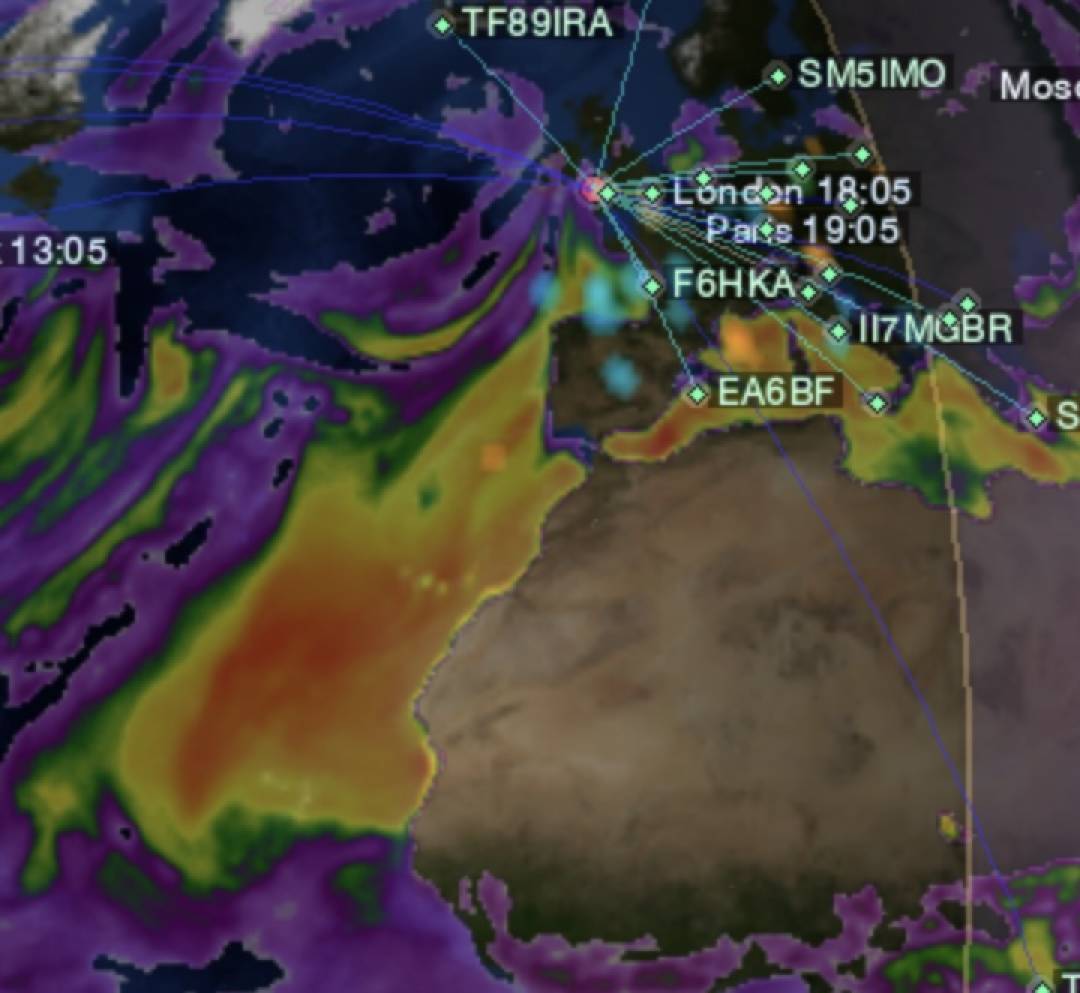
Not much to report on the radio yesterday, although I did get a couple of decodes of EA8CSB on 2m last evening. Fairly weak, but interesting to see out of the blue. You can see the tropo path in a screen grab from DX Chrono. Actually, that's for today, so the path looks like it's probably still there although I haven't seen an EA8...so far!
Today I had a few tasks to do in the morning, but was pleased to work TL8GD on 15m CW for a new DXCC. Heard him the other day on 20m, but didn't work him, so that worked out well.
Over breakfast I was listening to RI1FJL on 20m CW with a very big signal. I didn't manage to work out where they were listening in between dealing with emails and so on. They were still on the frequency when we got back from Haverfordwest about 4 hours later. Fortunately, I did manage to work out where they were listening this time and managed to work them first call. I've a feeling they are finishing today, so that will probably be my last QSO with them. Not the last activity from Frans Jozef Land though as RI1FJZ are due to start up fairly soon.
Bit of a busy day and didn't make it onto the air until the early evening, following shopping and then doing a cruise ship welcome up at the harbour.
TF89IRA a nice signal and good operator on 20m CW - getting through the pileup nicely.
Just missed an RS-44 pass in the evening but noticed FO-29 due. I hadn't tried FO-29 in a long, long while. Anyway, using OscarWatch, it wasn't too difficult to find myself on the downlink and I was pleased to work IK4JQQ. Didn't hear any DX on the pass when it was up over the Arctic, but I can keep an eye on FO-29 now.
With the solar flux barely over 100 today, the CWTs weren't too exciting. In the 13z one, I worked K6NA on 20m which was nice, but little DX apart from that. At 19z, I could hear a few west coast stations on 15m, but no east coast - could just hear John VE3EJ, but no chance of a QSO!
Nice sked with Roger GW5NF followed by a call from Martin 2E0XBZ from Bracknell. I've heard him on 80m AM and we had a good chat about AM.